Adjective for Kids: Definition, Types, Examples & Worksheet
Table of Contents
- What is an adjective?
- Why Are Adjectives Important?
- Types of Adjectives
- 1. Adjective of Quality
- 2. Adjective of Quantity
- 3. Adjective of Number
- 4. Demonstrative Adjective
- 5. Interrogative Adjective
- Examples of Adjectives in Sentences
- How to Identify an Adjective
- Practice Exercise (Level 1)
- Practice Exercise (Level 2)
- Practice Exercise (Level 3)
- Practice Exercise (Level 4)
- Answers
- Frequently Asked Questions
- What is an adjective in simple words?
- Why do we use adjectives?
- Can a sentence have more than one adjective?
- Conclusion
What is an adjective?
An adjective is a word that describes a noun or pronoun. It tells us more about a person, place, animal, or thing.
Quick Answer: An adjective is a word that describes a noun or pronoun, such as color, size, number, or quality.
Why Are Adjectives Important?
Adjectives are important because they make sentences more clear, detailed, and interesting. Without adjectives, sentences sound plain and do not give enough information.
- They describe how something looks (a red ball)
- They tell quantity (five apples)
- They add feeling (a happy child)
- They help us understand more clearly what a noun or pronoun is like
Example: This is a red ball.
Here, red tells us more about the ball.
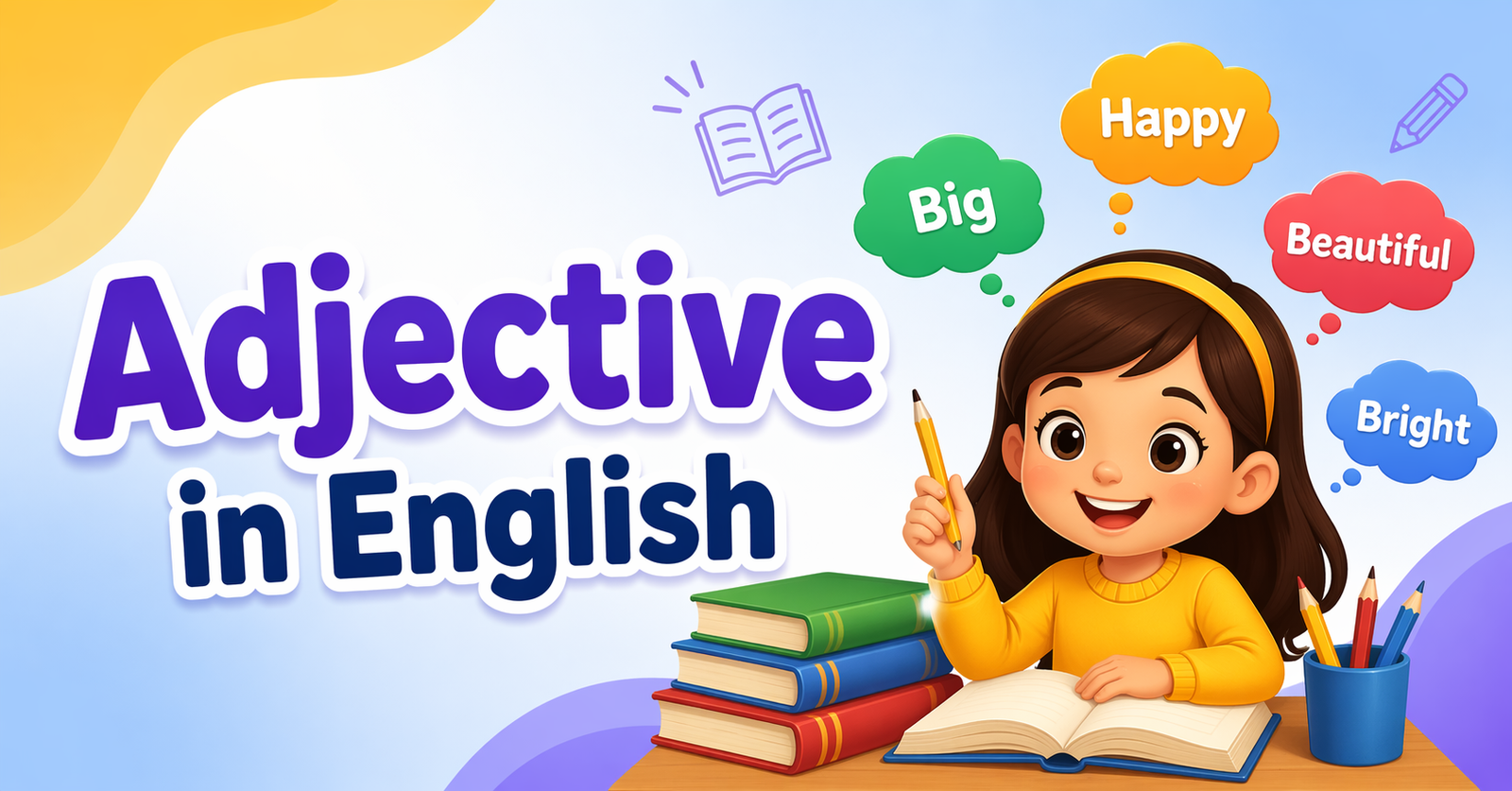
More examples: big, small, red, happy, five, beautiful
Types of Adjectives
1. Adjective of Quality
These adjectives tell us about the quality of a person or thing.
- good
- honest
- beautiful
- brave
2. Adjective of Quantity
These adjectives tell us how much of something is being talked about.
- some
- little
- enough
- much
3. Adjective of Number
These adjectives tell us how many people, animals, or things are being talked about.
- one
- two
- five
- many
4. Demonstrative Adjective
These adjectives point out specific things.
- this
- that
- these
- those
5. Interrogative Adjective
These adjectives are used with nouns in questions.
- which
- what
- whose
Examples of Adjectives in Sentences
- Riya is a smart girl.
- This is a big house.
- I have two pencils.
- He drank some milk.
- Which book is yours?
- The sky is blue.
How to Identify an Adjective
Ask:
- What kind?
- How many?
- How much?
- Which one?
The word that answers these questions is often an adjective.
Example: She has a blue bag.
Adjective: blue
Practice Exercise (Level 1)
Underline the adjectives:
- The small cat is sleeping.
- Riya is a clever girl.
- I have three books.
- This flower is beautiful.
- He drank some juice.
Practice Exercise (Level 2)
Fill in the blanks with suitable adjectives:
- The elephant is very ______.
- I have ______ pencils.
- This is a ______ dress.
- He is an ______ boy.
- She has ______ water.
Practice Exercise (Level 3)
Choose the correct adjective:
- I have (two / run) pens.
- She is a (beautiful / quickly) girl.
- This is a (red / eat) ball.
- He drank (some / jump) milk.
- Which (book / sing) is yours?
Practice Exercise (Level 4)
Make sentences using these adjectives:
- happy
- blue
- five
- smart
- this
📥 Free Adjective Worksheet (PDF for Kids)
Download printable worksheet and help your child practice easily.
📥 Download Worksheet (PDF)Answers
Level 1: small, clever, three, beautiful, some
Level 2: big, three/five, pretty/red, honest/smart, some/little
Level 3: two, beautiful, red, some, book
Frequently Asked Questions
What is an adjective in simple words?
An adjective is a describing word.
Why do we use adjectives?
We use adjectives to give more information about nouns and pronouns.
Can a sentence have more than one adjective?
Yes, a sentence can have two or more adjectives.
Conclusion
Adjectives make English more colorful and meaningful. Once children learn adjectives, they can write and speak in a better and more interesting way.
📄 Want a clean printable premium PDF?
Clean format • Watermarked • Perfect for revision
Download Premium PDF ₹40Also learn Noun in English, Pronoun in English, and Verb in English.
Want simple English grammar help for your child?
Explore guided English learning support with practice and worksheets.
View English Classes Book Free DemoContinue Learning
Related Articles