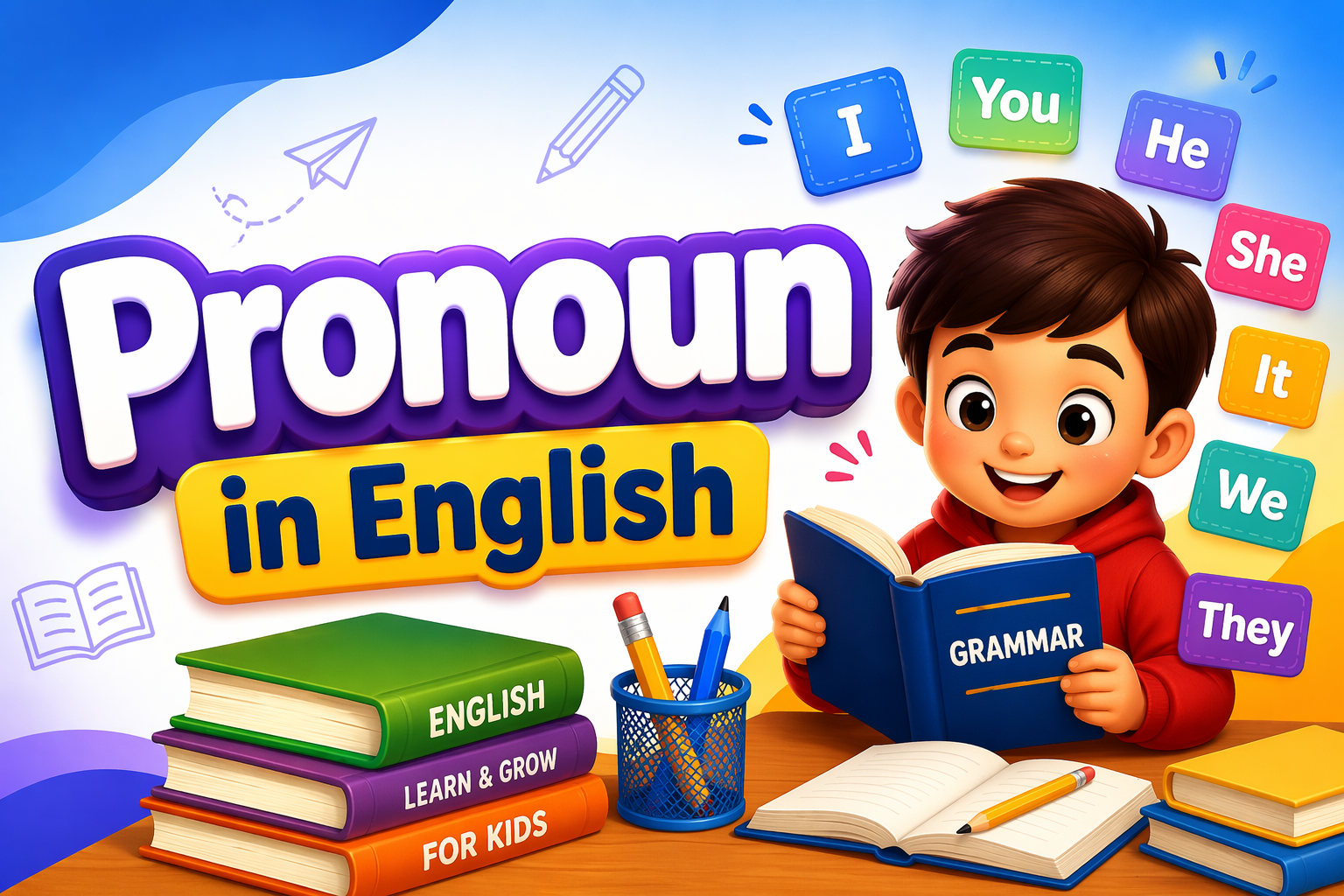
Pronoun in English – Definition, Types, Examples
Table of Contents
- Why Pronouns Are Important
- Definition of Pronoun
- Types of Pronouns
- 1. Personal Pronoun
- 2. Possessive Pronoun
- 3. Demonstrative Pronoun
- 4. Interrogative Pronoun
- 5. Reflexive Pronoun
- Examples of Pronouns in Sentences
- How to Identify a Pronoun
- Practice Exercise (Level 1)
- Practice Exercise (Level 2)
- Practice Exercise (Level 3)
- Practice Exercise (Level 4)
- Answers
- Frequently Asked Questions
- What is a pronoun in simple words?
- Why do we use pronouns?
- What is the difference between noun and pronoun?
- Conclusion
A pronoun is a word that is used in place of a noun. Pronouns make sentences shorter, easier, and less repetitive.
Why Pronouns Are Important
If we repeat the same noun again and again, the sentence sounds awkward. Pronouns help us speak and write more naturally.
Example: Riya is a girl. Riya is reading. Riya is happy.
Better: Riya is a girl. She is reading. She is happy.
Definition of Pronoun
A pronoun is a word used instead of a noun.
Examples: he, she, it, they, we, you, I
Types of Pronouns
1. Personal Pronoun
These pronouns are used for people or things.
- I
- you
- he
- she
- it
- we
- they
2. Possessive Pronoun
These show ownership.
- mine
- yours
- his
- hers
- ours
- theirs
3. Demonstrative Pronoun
These point to specific things.
- this
- that
- these
- those
4. Interrogative Pronoun
These are used for asking questions.
- who
- whom
- whose
- which
- what
5. Reflexive Pronoun
These refer back to the subject.
- myself
- yourself
- himself
- herself
- itself
- ourselves
- themselves
Examples of Pronouns in Sentences
- Riya is my friend. She is very kind.
- Rahul is absent because he is sick.
- This is my pen. It is mine.
- Who is knocking at the door?
- The children did the work by themselves.
How to Identify a Pronoun
Look for a word that is used instead of a noun.
Example: Amit is a student. He studies every day.
Pronoun: He (used instead of Amit)
Practice Exercise (Level 1)
Underline the pronouns:
- She is reading a book.
- They are playing in the garden.
- I am very happy today.
- We are going to school.
- It is raining outside.
Practice Exercise (Level 2)
Replace the noun with a pronoun:
- Riya is dancing. ______ is dancing.
- Rahul is my brother. ______ is my brother.
- The boys are playing. ______ are playing.
- My mother is cooking. ______ is cooking.
- The dog is barking. ______ is barking.
Practice Exercise (Level 3)
Choose the correct pronoun:
- ___ am a student. (I / He)
- Riya is absent because ___ is sick. (she / it)
- The book is on the table. ___ is new. (It / They)
- Rahul and I are friends. ___ study together. (We / They)
- This bag is ___. (mine / me)
Practice Exercise (Level 4)
Fill in the blanks with suitable pronouns:
- My name is Tina. ___ am in Class 4.
- Rahul is my friend. ___ is very helpful.
- These toys are ___.
- The children cleaned the room by ___.
- ___ is your best friend?
Answers
Level 1: She, They, I, We, It
Level 2: She, He, They, She, It
Level 3: I, she, It, We, mine
Level 4: I, He/She, ours/mine, themselves, Who
Frequently Asked Questions
What is a pronoun in simple words?
A pronoun is a word that takes the place of a noun.
Why do we use pronouns?
We use pronouns to avoid repeating the same noun again and again.
What is the difference between noun and pronoun?
A noun names a person, place, or thing, while a pronoun is used instead of that noun.
Conclusion
Pronouns make English easier and smoother. Once children understand pronouns well, they can form better sentences and improve speaking and writing skills.
📄 Want a clean printable premium PDF?
Clean format • Watermarked • Perfect for revision
Download Premium PDF ₹40Also learn Noun in English, Verb in English, and Tenses for Kids.
Want simple English grammar help for your child?
Explore guided English learning support with practice and worksheets.
View English Classes Book Free DemoContinue Learning
Noun | Verb | Free Worksheets
Related Articles