Tenses for Kids – Simple Explanation with Examples
Table of Contents
- Why Tenses Are Important
- What Are Tenses?
- 1. Present Tense
- 2. Past Tense
- 3. Future Tense
- Simple Tense Chart
- Examples with One Verb
- How to Identify the Tense
- Practice Exercise (Level 1)
- Practice Exercise (Level 2)
- Practice Exercise (Level 3)
- Practice Exercise (Level 4)
- Answers
- Frequently Asked Questions
- What are the 3 main tenses?
- Why do children need to learn tenses?
- How can I practise tenses easily?
- Conclusion
Tenses tell us the time of an action. They help us understand whether something happens now, happened before, or will happen later.
Why Tenses Are Important
Tenses make sentences clear and meaningful. If children learn tenses early, they can speak and write English more correctly.
What Are Tenses?
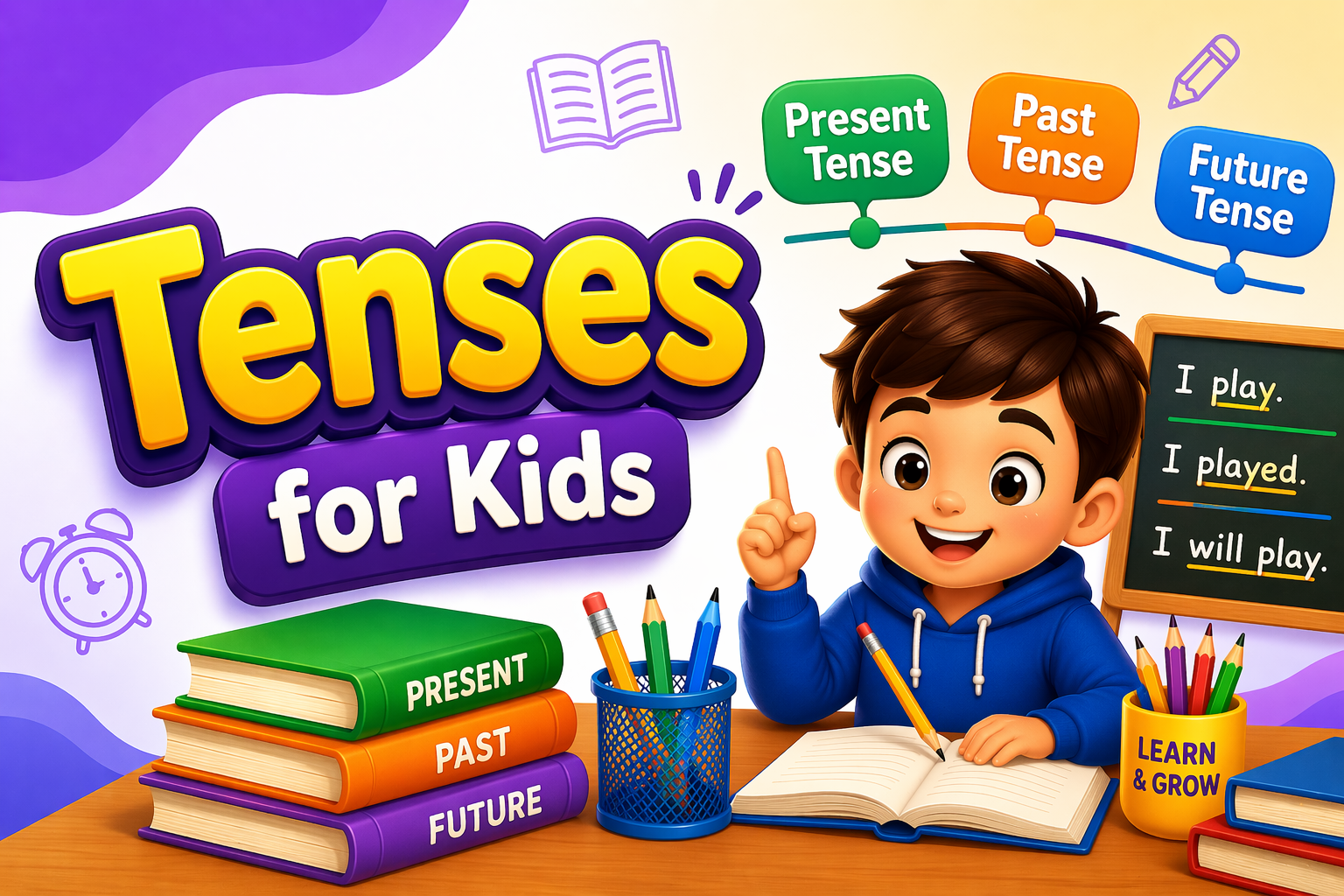
Tenses are forms of verbs that show the time of an action.
Main types of tense: Present Tense, Past Tense, Future Tense
1. Present Tense
Present tense tells us about actions happening now or regularly.
Examples:
- I go to school every day.
- She reads a story.
- They play in the park.
2. Past Tense
Past tense tells us about actions that already happened.
Examples:
- I went to school yesterday.
- She read a story last night.
- They played in the park.
3. Future Tense
Future tense tells us about actions that will happen later.
Examples:
- I will go to school tomorrow.
- She will read a story.
- They will play in the park.
Simple Tense Chart
Present: I eat an apple.
Past: I ate an apple.
Future: I will eat an apple.
Examples with One Verb
- Present: He writes a letter.
- Past: He wrote a letter.
- Future: He will write a letter.
- Present: They play football.
- Past: They played football.
- Future: They will play football.
How to Identify the Tense
Look for words like:
- Present: every day, always, now
- Past: yesterday, last week, ago
- Future: tomorrow, next week, later
Practice Exercise (Level 1)
Write whether the sentence is Present, Past, or Future:
- I play cricket.
- She went to the market.
- We will visit grandma.
- He reads every night.
- They watched a movie.
Practice Exercise (Level 2)
Change into Past Tense:
- I go to school.
- She eats an apple.
- They play football.
- He writes neatly.
- We read books.
Practice Exercise (Level 3)
Change into Future Tense:
- I go to school.
- She sings a song.
- They play cricket.
- He reads a book.
- We eat lunch.
Practice Exercise (Level 4)
Fill in the blanks:
- Yesterday I ______ to the park. (go)
- Tomorrow we ______ a movie. (watch)
- She ______ milk every day. (drink)
- Last week they ______ football. (play)
- I ______ my homework now. (do)
Answers
Level 1: Present, Past, Future, Present, Past
Level 2: went, ate, played, wrote, read
Level 3: will go, will sing, will play, will read, will eat
Level 4: went, will watch, drinks, played, am doing
Frequently Asked Questions
What are the 3 main tenses?
The 3 main tenses are Present Tense, Past Tense, and Future Tense.
Why do children need to learn tenses?
Tenses help children speak and write correct English sentences.
How can I practise tenses easily?
Practice sentence changes, fill in the blanks, and daily speaking examples.
Conclusion
Tenses are a basic but very important part of English grammar. When children learn present, past, and future tense clearly, they become more confident in speaking and writing.
📄 Want a clean printable premium PDF?
Clean format • Watermarked • Perfect for revision
Download Premium PDF ₹40Also learn Noun in English, Pronoun in English, and Verb in English.
Want simple English grammar help for your child?
Explore guided English learning support with practice and worksheets.
View English Classes Book Free DemoContinue Learning
Noun | Verb | Free Worksheets
Related Articles